Articles
Curtailment: Put a Number on It Before You Buy a Site
Written by The Noda team
Curtailment is lost export. Before you buy a renewable-energy site, turn that loss into an hourly model and tie every assumption to a document or operator dataset.
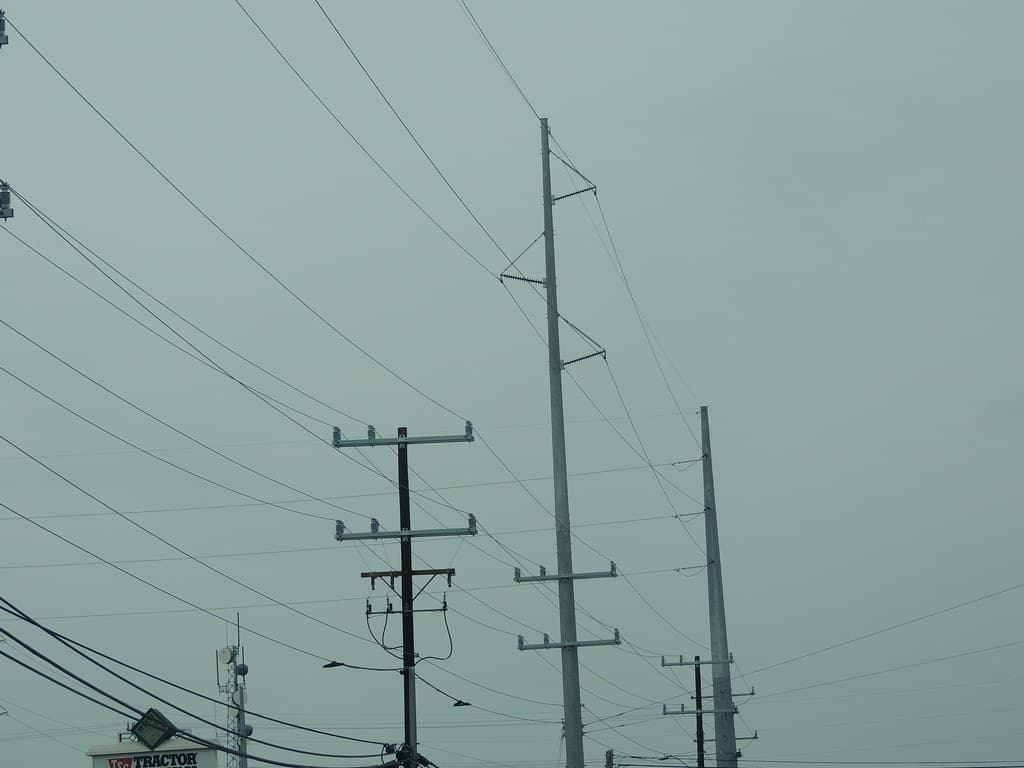
The answer is a forecast, not a single percentage. It depends on the export limit, the hours when the network is constrained, the plant's generation profile and the terms that govern payment. Delmarva Power 138kV & Milford Electric Division 24.9kV - Milford, DE, by Tonyglen14, via flickr, (CC BY 2.0). Original: https://www.flickr.com/photos/85517748@N02/40212307601. Licence: https://creativecommons.org/licenses/by/2.0/
What does curtailment mean for a renewable-energy project?
Curtailment is an instruction or condition that prevents a generating plant from exporting all the power it could produce. The plant can be available and the wind or sunlight can be present, while the point of connection accepts less export.
The constraint can come from the local network, the wider transmission system or the commercial terms of the connection. A flexible connection can make the limit explicit. A firm connection can still face system actions where the relevant market rules allow them. The document that matters is the one that states who can restrict export, in which conditions and with what payment treatment.
Curtailment removes physically exportable MWh. Whether the project sells fewer MWh or receives a payment for constrained energy depends on the settlement and offtake terms. It can also remove the hours with the highest value, so an annual loss percentage alone does not settle the investment case.
How do you calculate the output curtailment takes?
Start with the plant's unconstrained hourly generation profile. Apply the export limit for each hour in the operator's constraint case, then calculate the difference between available generation and permitted export.
For each hour, use max(0, unconstrained generation MWh - permitted export MWh) where the export limit is below available generation. Exclude equipment outages, resource shortfalls and other availability losses before attributing the remainder to network curtailment.
Run the result through the financial model using the price assumption for each hour. Keep the physical energy loss and the value recovered under the settlement terms as separate outputs. A site that loses the same annual MWh in winter overnight hours and in sunny summer hours does not have the same business case.
For solar, the generation profile concentrates the loss into daylight hours. For wind, the affected hours follow the wind resource and the network condition. A battery changes the dispatch profile only where its charging, duration, export and operational permissions allow it to absorb the energy.
The result should be a time series with the source and age of every input. A rounded annual percentage without the hourly pattern cannot show whether the model has captured the hours that decide revenue.
What evidence settles curtailment risk before acquisition?
Ask for evidence in this order:
- The connection offer or agreement, including the export capacity, restriction rights and payment provisions.
- The operator's connection and system studies, with the model assumptions and the reinforcement or constraint case that produced the result.
- Historical constraint, dispatch or curtailment data for the relevant network area, where the system operator or network operator publishes it.
- The project's metering, availability and generation data, so the model separates a network restriction from an equipment outage.
- The revenue model, including the treatment of curtailed energy under the route to market, PPA or other offtake agreement.
The DNO or transmission system operator assesses the network condition. The developer supplies the plant and export assumptions. The investor tests whether the evidence supports the forecast used in the acquisition model.
Public data is useful for identifying a pattern. It does not prove what a particular connection offer will do. The operator's study and the executed connection terms carry the project-specific answer.
Does curtailment compensation remove the risk?
Compensation is a contract question. Some arrangements pay for constrained energy under defined conditions. Others leave the project exposed to lost output, or compensate only for a specified instruction or period.
Read the clause against the physical constraint. Check who issues the instruction, how the baseline generation is established, which losses are excluded and whether the payment survives a change in route to market. A headline reference to curtailment compensation does not establish the amount recovered by the project.
Redispatch is related but distinct. It describes a system action and its settlement route, while curtailment describes the reduction in the plant's export. The allocation of cost and payment depends on the market and the applicable terms. Noda has set out how redispatch costs reach a renewable project.
What does Noda's screening record show about export constraints?
The current aggregate does not publish a curtailment-only percentage. It does show the screening outcomes that make the limitation of an early answer clear: in the 28 runs from 5 July to 10 August 2026, 23 did not pass screening and five required high-risk or follow-up treatment. Not one run returned a clean pass. The cohort is small, the platform is still being built, and the result reflects which sites entered an early private-beta screening process rather than the wider project population.
That result is a screening signal, not a measured fleet-wide curtailment rate. It tells an investor that a site-level export assumption needs evidence before the acquisition case is trusted. It does not tell the reader that 23 sites were curtailed, because the aggregate does not make that claim.
A preliminary screening report does not replace the operator's official grid study. It marks what is source-backed, modelled, estimated or missing so the next request can target the missing evidence.
What should you do before you buy the site?
The developer should obtain the connection terms, the latest operator study and the time-series assumptions behind the yield and export model. If the project uses a flexible connection, the developer should model the restriction rights as an operating condition rather than as a footnote.
The investor should ask for the unconstrained and constrained yield files side by side. The difference should reconcile hour by hour to the export limit, the operator case and the revenue treatment. If those files cannot be reconciled, the curtailment assumption is missing evidence.
The operator's published data can test the wider constraint pattern. It cannot replace the project-specific study. A preliminary screening assesses the export and grid evidence available before formal diligence, while the operator remains responsible for the official assessment. See the renewable-energy investor page for the relevant reader group.
This article was written automatically from Noda's own screening data and checked against the official sources it cites. Editorial responsibility rests with Noda.
Back to all articles
Same series
Each article answers one question in the same screening workflow, so they are worth reading together.
Levelised cost of electricity: what LCOE leaves out
LCOE compares average generation cost, but leaves out connection, timing, revenue and delivery risks that decide whether a renewable site is worth building.
Interconnector: how it changes your capture price
An interconnector reshapes hourly prices across bidding zones. Learn how to test its effect on renewable capture price, outages, congestion and contracts.
Redispatch: what it costs a renewable project and who pays
Redispatch can reduce a project's delivered output after connection. Learn when it occurs, who settles the cost and which evidence belongs in the model.