Articles
Redispatch: what it costs a renewable project and who pays
Written by The Noda team
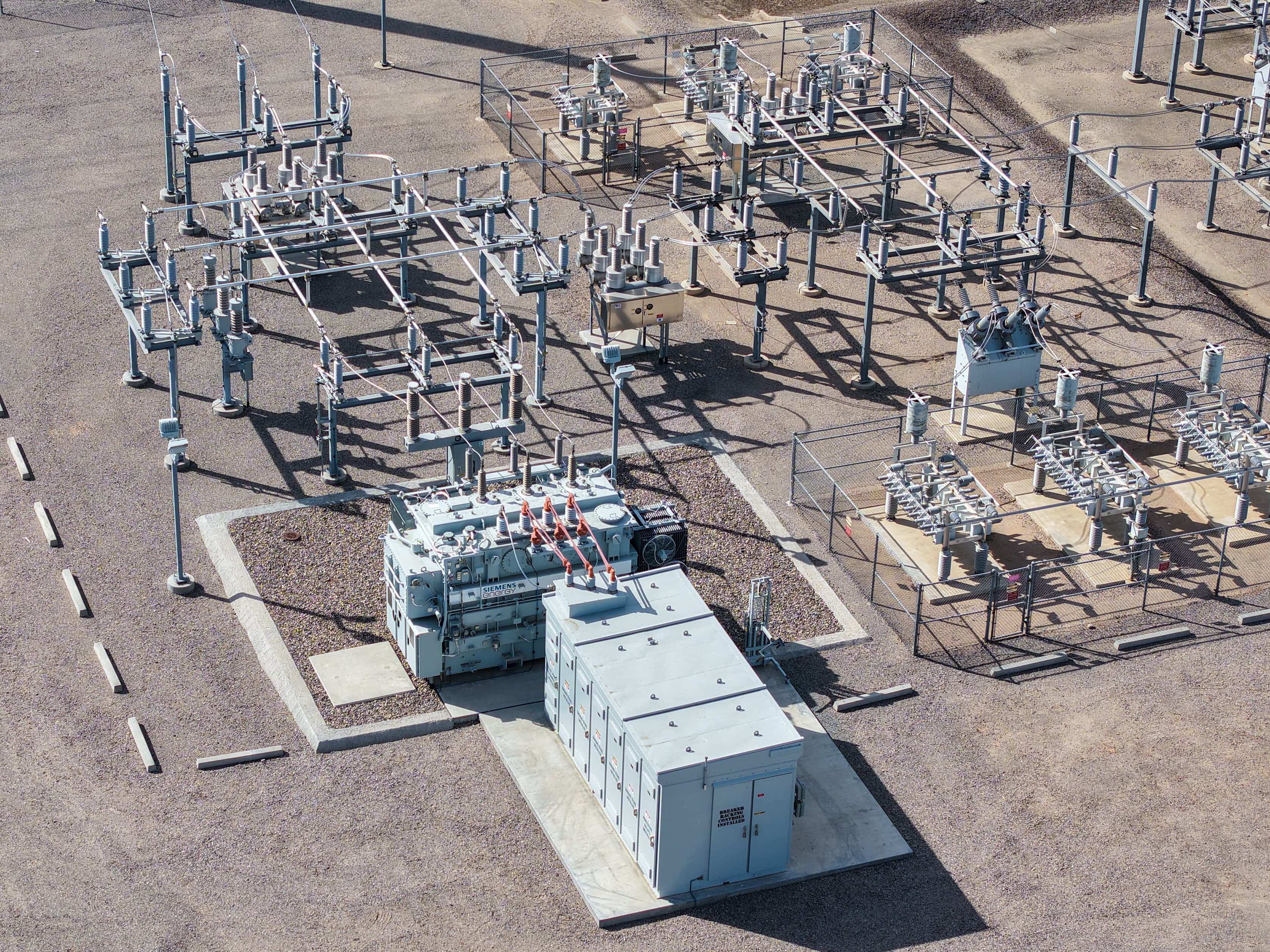
A grid operator can change a project's active-power output after the project has secured a connection. Redispatch is the congestion-management instruction behind that change. It can remove export from the forecast without changing the project's installed capacity. Distribution substation switchgear, by Rsparks3, via Wikimedia, CC0 1.0: https://creativecommons.org/publicdomain/zero/1.0/deed.en/
What does redispatch mean?
Redispatch is a request from a network operator to adjust the active-power output of one or more plants so that a bottleneck is avoided or removed. A common pattern is for one plant to reduce output while another increases output, changing where electricity enters the grid. Total generation can remain broadly unchanged, but that result is not guaranteed.
The operator decides that action through grid calculations. Planned outages, unexpected incidents, weather and renewable generation all affect the result. A wind or solar project can therefore face redispatch even when its own equipment is available and its connection agreement remains in force.
The mechanism operates within European electricity-market frameworks, national implementations and, in some cases, cross-border arrangements. The applicable market's rules determine how an instruction is issued and settled.
When does redispatch hit a renewable project?
Redispatch reaches a project when the operator's model shows that the network cannot safely carry the expected power flow. The trigger can be a local circuit constraint, a transmission bottleneck elsewhere in the system, an outage, or a combination of generation and demand in a particular period.
The project can be instructed before the constraint occurs. In Germany, the transmission system operators publish redispatch measures and distinguish the TSO that requests a measure from the TSO that instructs the connected plant. That distinction matters when a congestion problem crosses control areas.
A connection offer answers whether the project can connect under its stated conditions. It does not guarantee that every available megawatt will be exported in every dispatch period. Redispatch sits in that gap.
Who pays for redispatch?
The answer depends on the market's settlement rules and on the type of instruction. The plant owner may receive compensation for a downward adjustment, while the system cost is recovered through the arrangements set by the relevant network and market institutions. A developer cannot treat the word "compensation" as a universal revenue guarantee.
Germany shows why the distinction matters. The Netztransparenz transparency page says that redispatch includes renewable plants and storage facilities, and publishes adjustments and their balancing treatment. Germany's framework also assigns roles to requesting and instructing TSOs. Those details cannot be carried into a UK, French or Spanish model without checking that market's rules.
For a project model, split the question into two accounts:
- Lost generation: the energy the plant was instructed not to produce, including the price and contract treatment applied to that volume.
- System settlement: the compensation, balancing and network-cost treatment defined by the market's rules and the project documents.
Do not put one generic redispatch line into the cash flow. Identify who issues the instruction, who settles the adjustment, what evidence records the event and which party carries the residual risk.
What does Noda's screening record show?
Noda's screening record does not measure redispatch frequency. It measures whether a network constraint is present in the preliminary evidence for a site, and the constraint is one reason a project may need deeper operator analysis.
From 5 July to 10 August 2026, 28 screening runs carried a verdict. Twenty-three did not pass screening, and five were marked high risk or requiring follow-up. This is a small sample. It is a screening cohort weighted by the sites submitted to the private beta, and the failure share reflects a platform still being built as much as it reflects the sites. It is not a European redispatch rate.
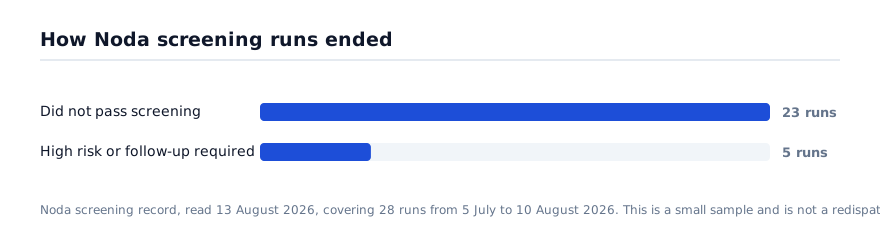
The result is useful at an earlier stage. A network constraint should change the diligence question before the project reaches an operator's formal study: what is the affected constraint, which dispatch states were tested, and how does the settlement mechanism treat the curtailed output?
A preliminary screening report does not replace an official grid study.
What does a redispatch order change in the model?
A redispatch instruction changes the project's delivered output for the affected interval. The model must then carry the instruction through yield, revenue, balancing, debt service and any contracted delivery obligation.
The decisive inputs are the operator's constraint evidence, the project's export limit, the expected dispatch pattern and the settlement terms. A site with a strong annual yield can still have a weak case if its constrained hours overlap with high-value generation or a delivery obligation that cannot be met from another source.
The missing input is often the event history. A public congestion page may describe the mechanism without telling a buyer how often a proposed point of connection has been constrained under the dispatch pattern the project will create. Ask for the operator's study, connection conditions and any available constraint record. Treat estimates separately from source-backed results.
What should a developer check before optioning a site?
Start with the point of connection and the export the project is asking for. Ask the network operator or system operator which constraint limits that export, when the constraint appears, and whether the proposed connection is firm, flexible or subject to dispatch instructions.
Then check the commercial documents. The developer should identify the instruction recipient, the settlement party, the evidence required for a claim, the treatment of lost output and the allocation of balancing costs. The investor should require those assumptions in the base case and downside case, rather than accepting one annual curtailment percentage.
The developer screening workflow can organise that evidence before formal diligence. Investors can use the same record when reviewing renewable project investment decisions, where the issue is the cash-flow treatment rather than the terminology.
The governing source remains the operator's study and the applicable national settlement rules. Noda returns a preliminary risk report. It does not approve a connection or replace the operator's analysis.
This article was written automatically from Noda's own screening data and checked against the official sources it cites. Editorial responsibility rests with Noda.
Back to all articles
Same series
Each article answers one question in the same screening workflow, so they are worth reading together.
Levelised cost of electricity: what LCOE leaves out
LCOE compares average generation cost, but leaves out connection, timing, revenue and delivery risks that decide whether a renewable site is worth building.
Interconnector: how it changes your capture price
An interconnector reshapes hourly prices across bidding zones. Learn how to test its effect on renewable capture price, outages, congestion and contracts.
Curtailment: Put a Number on It Before You Buy a Site
How to model curtailment before acquisition, separate lost MWh from lost value, and test the connection evidence behind an export assumption.