Find powered land for data centers
Name the load and the area. Noda reads the grid operator’s demand capacity at each substation nearby, then looks for flat land beside the ones that can take it, clear of flood zones and protected areas, with water and fibre close by.
Ask for the power first, then the land
Noda reads the demand tables, says what they mean for your load and ranks the areas where a connection is most likely. The example: 100 MW within 60 km of Madrid, Spain.
Madrid-ring 220/400 kV nodes: room the static criterion would hold vs demand already granted
Red Eléctrica demand access table of 1 Oct 2026, MW. Free capacity for new requests is 0 MW at every one of these nodes.
No node within 60 km of Madrid can give you a firm 100 MW today. Red Eléctrica's table of 1 October 2026 shows 0 MW free for new demand at all 91 Madrid-region nodes, and at the neighbouring Toledo and Segovia nodes too. The shared stability limit of the central zone has no margin. I found no distributor node that can help either: i-DE has 0 MW at 66 and 132 kV and at most 29.8 MW at 15 or 20 kV. Naturgy's UFD (edition of 9 Sep 2025, the latest I could read) offers at most 13.2 MW, at a 45 kV inner-city node.
The best realistic route is to buy an existing permit or to get in line behind the stability limit. The earliest firm 100 MW permit I can defend is 2027 H2 if you buy a permit, 2028 H2 otherwise, with energisation around 2031. The range is permit 2027 to 2031 and energisation 2030 to 2033. These are our estimates from the records below, not an operator date.
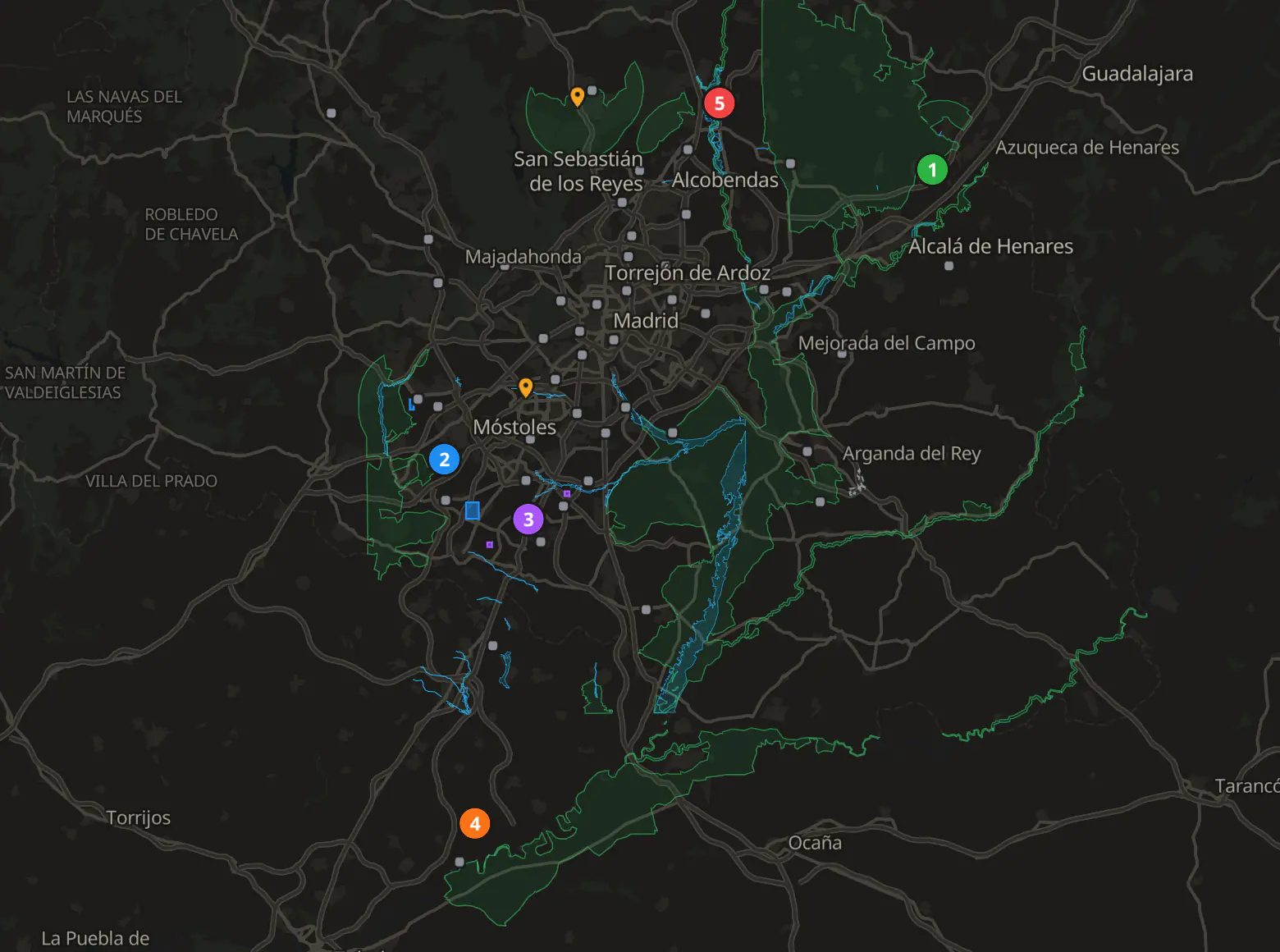
The map now shows the ranked sites, the substations and the flood and protected-area layers.
Why every node is at zero
Static room exists, but it can't be granted. The binding limit is a dynamic stability criterion shared across the central zone, and the ministry itself says network investment can't raise it. The fix would be a decree making demand ride through voltage dips. It is still a draft, and on 13 October the Council of Ministers only approved fast-track processing. The next table is due 1 November, but the reference scenario isn't refreshed before 2028.
The chart above shows the room each node would hold if the limit lifted, next to what is already granted.
Ranking of the areas
| # | Area | Best site found | Grid angle | Main risk |
|---|---|---|---|---|
| 1 | East, Henares (Meco, Loeches, San Fernando, Anchuelo) | 42 ha at Meco, 1.6 km from the 220 kV station | 484 MW granted at Loeches and San Fernando to Ignis/TotalEnergies, 257 MW at Anchuelo, 445 MW room left at Anchuelo | The room sits at Anchuelo, 9 km from the land, and ZEPA/LIC lies 0.33 km away |
| 2 | West (Villaviciosa, Moraleja) | 38.6 ha at the Villaviciosa 400 kV fence, plus 195 ha flat at Moraleja | Villaviciosa 400: 586 MW room, 213 MW granted to Solaria | 0.4 km from the Guadarrama park and Natura 2000 edge, and fragmented parcels at Moraleja |
| 3 | South (Parla, Pinto, Valdemoro) | Two 20 ha sites beside Parla 220 and Pinto 220 | Valdemoro has 171 MW room, and Fortuna and Prado Santo Domingo are tender nodes | Flat plots only 20 to 30 ha, no room at Parla or Pinto |
| 4 | Toledo (Seseña, Aceca) | 49 ha, the flattest site found, 4.2 km from Aceca | Aceca: 167 MW room, 177 MW granted | Rural land needing a plan change, a 220 kV line over the plot, 52 km out |
| 5 | North (Algete, La Cereal) | 25 ha near Algete | Algete 220 and La Cereal 400 are tender nodes, with 518 to 573 MW room at La Cereal and SS Reyes | Site is zoned protected (Vega del Jarama park) |
East and West are close. West wins if Solaria's 213 MW permit at Villaviciosa turns out to be for sale, and East wins on fibre.
East has the densest data-centre cluster (Alcalá, San Fernando, Meco) and the most granted permits in one corridor. Water there is Canal de Isabel II, with the Meco treatment plant 2.7 km and the Henares canal 0.4 km away. West has the Villaviciosa treatment plant 1.9 km from Moraleja, which is the best reclaimed-water option I found, but fibre there is a proxy only.
Morata (south-east) is on the watch list, not the ranking. It holds the largest room in the region at 1,819 MW, so it would open first if the limit lifts. But its 94 ha patch was read from OSM only, with no cadastre, and the substation sits inside the Parque Regional del Sureste polygon.
Doors to a connection
- Buy a granted permit. The law allows transfers, but a permit lapses if its centroid moves more than 10 km or the activity code changes, so you buy the project with its land. No public market exists. The four big Madrid permits face their first test on 1 October 2027, when 10% of the network payment is due. The engineer's estimate is a 30 to 40% chance a willing seller appears; that is a judgment, not a calibrated figure.
- Tender. Algete, Fortuna, La Cereal and Prado Santo Domingo have been eligible since September 2024 to December 2025. No call has been published and the selection order does not exist. Only applicants who filed during the one-month notice can bid, so a newcomer is probably shut out. Algete alone has 465 MW of rival requests.
- Flexible access. A CNMC resolution has been in force since 1 September 2026, and transmission requests open on 1 March 2027. It works where firm capacity is zero, but you must cut to zero on the operator's signal. That is hard to square with a data-centre service level.
- Capacity freed by permit holders who gave up capacity. The statutory list was due on 22 August and isn't published, so no node or MW is known.
What Red Eléctrica must confirm
- Whether your chosen node and zone can be released from the dynamic limit, and when. Ask for the node-specific result for a power-electronics load, with and without voltage-dip ride-through.
- Whether a free bay or position exists at the named substation, at 220 or 400 kV, and what network works the connection needs. The Loeches 220 kV reinforcement was still in public information in May 2026.
- The status of each granted permit you might buy: holder, milestones and acceptance of a change of holder.
- Whether a newcomer can enter a tender at Algete, La Cereal or Fortuna, and when a call is expected.
- Whether type 3 flexible access is open at the node, and on what terms until the dedicated-position rule ends in 2029.
- Short-circuit strength, protection and metering requirements for the node.
Land, water and fibre caveats
- Land need: 20 ha holds about 100 MW if the halls are multi-storey. That is my estimate. The south engineer worked from one announced campus of 300 MW on 900 ha and concluded 100 MW needs 300 ha. I treat that as an upper case.
- Planning class: it is unread for West, South and Toledo, and "no protected area" in my screen means no Natura 2000 or national designation.
- Water: an air-cooled design needs roughly 0.1 to 0.5 million m³ a year, and evaporative about 1.5 to 2.5 million. No river or reclaimed-water concession was read.
- Fibre: I used proxies only, such as rail, motorway and nearby data centres. Carrier route maps are the confirming record.
- Parcels: cadastral parcel data was rate-limited, so parcel ownership isn't settled anywhere. The Morata patch is the weakest read.
The decision this feeds is which area to option land in and which permit holders to approach. Nothing yet confirms a connection date, so don't commit to land before Red Eléctrica or a permit holder answers.
I cross-checked planning classifications at the west and south sites (18 October national land-class layer) and confirmed the ranking: west's Villaviciosa south site is mostly urbanizable while Moraleja east and the south sites are rural, requiring plan changes for a data centre. I've saved the top East/West/South sites with their grid, land, and planning data, plus the ranking brief and node capacity table, to your project files.
Ranking brief and node capacity table, Red Eléctrica 1 Oct 2026
Suggestions
Draft the Red Eléctrica enquiryFind who holds the Madrid permitsScreen East and West in fullZero is an answer, with a reason. Red Eléctrica’s table showed 0 MW free for new demand at every node within 60 km. Noda found why: a stability limit shared by the whole central zone, which grid investment does not raise.
Dates come marked as estimates. The earliest firm permit Noda could defend is the second half of 2027, if you buy a granted one. The answer says this is its estimate from the records, not an operator date.
How Noda looked for power, then for land
It split the work: two engineers on the grid and six on land, one area each, at the same time. Every step is recorded, failed tries included.
8 engineers, 41 minutes
- Read the operator’s demand table.0 MW free at all 91 Madrid-region nodes
- Check the distributors’ tables.At most 29.8 MW at any of their nodes
- Map the 46 nodes within 60 km.Three of them are tender nodes
- Find out why every node is at zero.A stability limit shared by the central zone
- Send an engineer to each land area.West, Henares, north, south-east, south, Toledo
- Dead end: The cadastral parcel service.Rate-limited. Owners left open.
- Screen 20 ha of flat land near each substation.Slope, flood zones, Natura 2000, parks, water and fibre
- Rank the five areas.Morata goes on a watch list: its land was read from OSM only
- Dead end: The first water demand figure.A unit error. Worked out again.
- Read the planning class at the west and south sites.Rural land there needs a plan change
- Save the sites, the brief and the node table to your project.
Result. No substation within 60 km of Madrid can give a firm 100 MW today. The earliest firm permit Noda could defend: the second half of 2027 if you buy a granted one, the second half of 2028 if you wait, with power on around 2031. East (Meco) and west (Villaviciosa) lead the five areas.
Keep the ranking next to the map
Noda saved a one-page brief and the node table to the project, with the three best sites. The next question starts from them.
100 MW data centre within 60 km of Madrid: area ranking, 18 Oct 2026
Grid verdict: Red Electrica's demand table of 1 Oct 2026 shows 0 MW free for new demand at every transmission node within 60 km of Madrid. The limit is the dynamic criterion of the shared central zone (margin 0). Distribution nodes show at most 29.8 MW (i-DE, 15/20 kV) and 13.2 MW (UFD, 45 kV, edition 9 Sep 2025).
| Rank | Area | Best site | Planning class | Grid angle |
|---|---|---|---|---|
| 1 | East, Henares | Meco NE, 42.3 ha | urbanizable no delimitado | Anchuelo 445 MW room, Loeches 386, San Fernando 665; 484 MW granted at Loeches and San Fernando |
| 2 | West, Villaviciosa/Moraleja | Villaviciosa south 38.6 ha (21 ha urbanizable), Moraleja east 195.6 ha (rural) | mixed / no urbanizable | Villaviciosa 400: 586 MW room, 213 MW granted |
| 3 | South, Parla/Pinto | Parla west and Pinto south, 20 ha each | no urbanizable | Valdemoro 171 MW room; Fortuna and Prado Santo Domingo tender nodes |
| 4 | Toledo, Sesena/Aceca | Sesena south 49 ha | rural | Aceca 167 MW room, 177 MW granted |
| 5 | North, Algete | 25 ha | protected rural | Algete and La Cereal tender nodes |
| Watch | Morata | 94 ha (OSM only) | not read | Morata 400: 1,819 MW room |
Doors: buy a granted permit (earliest 2027 H2, our estimate), tender at Algete/Fortuna/La Cereal/Prado Santo Domingo (eligible, no call published), flexible access type 3 (requests open 1 Mar 2027), capacity freed under RDL 7/2026 DT3 (list not published). Base case: firm permit 2028 H2, energisation about 2031.
Open with Red Electrica: node release from the dynamic limit, bay availability and works, change of holder for granted permits, tender entry, flexible access terms, short-circuit and protection requirements. Open on land: municipal plan use rules, cadastral owners (rate-limited), carrier fibre routes, CHT water concession.
19 lines · Markdown
Then ask the operator what only it can confirm
The answer ends with the questions for Red Eléctrica and the routes to a connection that are still open.
Six things Red Eléctrica must confirm
- Whether the node can be released from the stability limitAnd when, for a power-electronics load
- Whether a free bay exists at the substationAt 220 or 400 kV, and the works the connection needs
- The status of each granted permit you might buyHolder, milestones, change of holder
- Whether a newcomer can enter a tenderAt Algete, La Cereal or Fortuna, and when a call comes
- Whether flexible access is open at the nodeAnd on what terms until 2029
- Short-circuit strength, protection and metering
Four routes to a connection the run found
- Buy a granted permitYou buy the project with its land; a permit lapses if it moves more than 10 km
- Bid in a tenderFour tender nodes, no call published yet
- Flexible accessRequests open on 1 March 2027; you cut to zero on the operator’s signal
- Capacity that permit holders give upThe list was due on 22 August and is not published
The next step Noda offered: draft the enquiry to Red Eléctrica. Nothing is sent.
Use cases for finding powered land
Each one opens Noda with a first message you can change before you send it.
Questions about finding powered land
Something else? Write to hello@noda.energy.
Land with a grid connection for a large load, such as a data center, or a clear route to one. For a data center the power decides the site, so Noda starts with the substations that can supply the load and then looks for land beside them.
In the capacity the grid operator publishes for demand connections, and in the distributors' tables. In the Madrid run it read Red Eléctrica's table of 1 October 2026 and the tables of i-DE and UFD, and put the 46 transmission nodes within 60 km on the map. Where an operator publishes nothing, Noda says so.
Noda says why and lists what is still open. Around Madrid every node within 60 km showed 0 MW free, because of a stability limit shared by the central zone. Noda listed four routes: buy a granted permit, bid in a tender, flexible access, and capacity that permit holders give up, with what is known about each one and the questions the operator must answer.
Area and slope, flood zones, Natura 2000 and other protected areas, planning class, cadastral parcels, water and fibre. Each map layer names its source and the date it was read. In the Madrid run: slope from a 30 m terrain model, flood zones from MITECO's SNCZI map, protected areas from the EEA. When a source fails, Noda says so: the cadastral service was rate-limited, so parcel owners stayed open.
It depends on the design. In the Madrid run Noda estimated about 20 ha with multi-storey halls and marked that as its estimate. One of its engineers worked from an announced campus of 300 MW on 900 ha and got 300 ha; Noda kept that as the upper case.
Yes. Name the country and the load. Noda finds that country's grid operator data and land records, and where nothing is published it says so. The use cases below open with examples in Germany, Spain, Poland and Romania.
Where should your data center plug in?
Ask in your own words. You can attach a PDF, KML, GeoJSON, CSV or Excel file.
Have an account? Log in